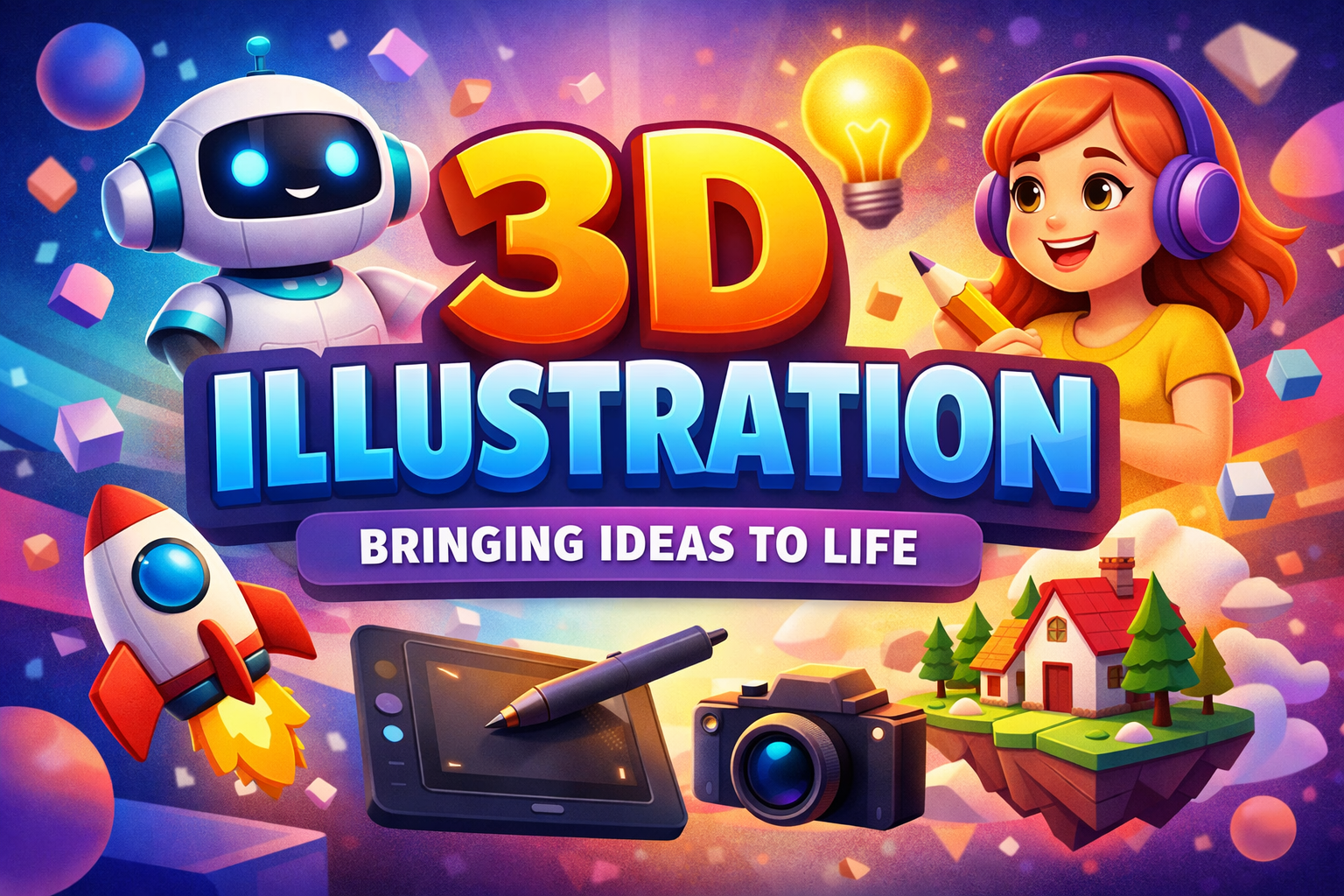
In today’s fast-evolving digital landscape, visual storytelling has become one of the most powerful ways to communicate ideas. Among the many visual mediums available, 3D illustration stands out as a dynamic and immersive form of digital art that combines creativity, technology, and realism. From advertising campaigns and product visualization to animation and branding, 3D illustrations are transforming the way brands and creators present their ideas.
What is 3D Illustration?
3D illustration is the process of creating three-dimensional visual artwork using digital software. Unlike traditional 2D images, 3D illustrations have depth, lighting, texture, and perspective, making them appear more realistic and visually engaging.
Artists use specialized software to model objects, apply materials, set lighting, and render scenes that can replicate real-world environments or completely imaginative worlds.
This ability to control every element of a scene allows designers to produce visuals that are both creative and highly detailed.
Why 3D Illustration is Becoming So Popular
The demand for 3D illustration has increased dramatically in recent years, particularly in digital marketing and product design. Businesses are increasingly adopting 3D visuals because they offer a more immersive and visually compelling experience.
Here are some reasons why 3D illustration is gaining popularity:
Enhanced Realism
3D illustrations can simulate real-world lighting, shadows, and materials, making visuals look incredibly lifelike.
Creative Freedom
Artists can create anything imaginable from futuristic environments to stylized characters without the limitations of physical photography.
High Engagement
3D visuals attract more attention and engagement on websites, social media, and advertisements compared to flat graphics.
Versatility
3D illustrations can be used in websites, product presentations, video games, advertising campaigns, and animation.
Applications of 3D Illustration
3D illustration is widely used across multiple industries because of its ability to communicate complex ideas visually.
Product Visualization
Brands use 3D illustrations to showcase products before they are even manufactured. This is particularly useful in industries like automotive, electronics, and consumer goods.
Marketing and Advertising
3D visuals create eye-catching promotional content that stands out in crowded digital spaces.
Entertainment and Media
Movies, games, and animated series rely heavily on 3D illustration for world-building and character design.
Website and UI Design
Modern websites often use stylized 3D graphics to create interactive and memorable user experiences.
The Role of 3D Illustration in Branding
Strong branding requires visuals that capture attention and communicate identity clearly. 3D illustrations allow brands to build unique visual styles that differentiate them from competitors.
Companies often use 3D elements in:
- Website hero sections
- Social media campaigns
- Product showcases
- Promotional animations
These visuals not only improve aesthetic appeal but also help brands build a memorable visual identity.
The Future of 3D Illustration
With advancements in rendering technology, real-time graphics, and artificial intelligence, the future of 3D illustration is incredibly promising. Industries such as virtual reality (VR), augmented reality (AR), gaming, and digital marketing are rapidly expanding their use of 3D visuals.
As technology continues to evolve, 3D illustration will become even more accessible and integrated into everyday digital experiences.
Conclusion
3D illustration has become an essential tool in modern digital design. By combining artistic creativity with advanced technology, it allows creators to produce visually rich and engaging experiences that capture attention and communicate ideas effectively.
For businesses, marketers, and creators, investing in high-quality 3D illustration is not just about aesthetics — it is about creating impactful visual stories that connect with audiences in a powerful way.
Leave a Reply